
World Metrology Day: Building Trust in Policymaking

World Metrology Day: Building Trust in Policymaking
May 20, 2026
The 2026 theme for World Metrology Day mirrors the foundational principles of operations at PQI and Advanced Inspection Services: Good decisions depend on good data – and good data depends on valid measurements.
Measurement data serves as the foundation for critical decisions made across industries. Those decisions shape product design, acceptance tolerance, production guidelines, and impact safety and performance at scale. When data behind decisions is valid, traceable to recognized standards, statistically repeatable, and within acceptable measurement uncertainty, those decisions become clear and defensible.
The Role of Metrology: More Than a Final Check
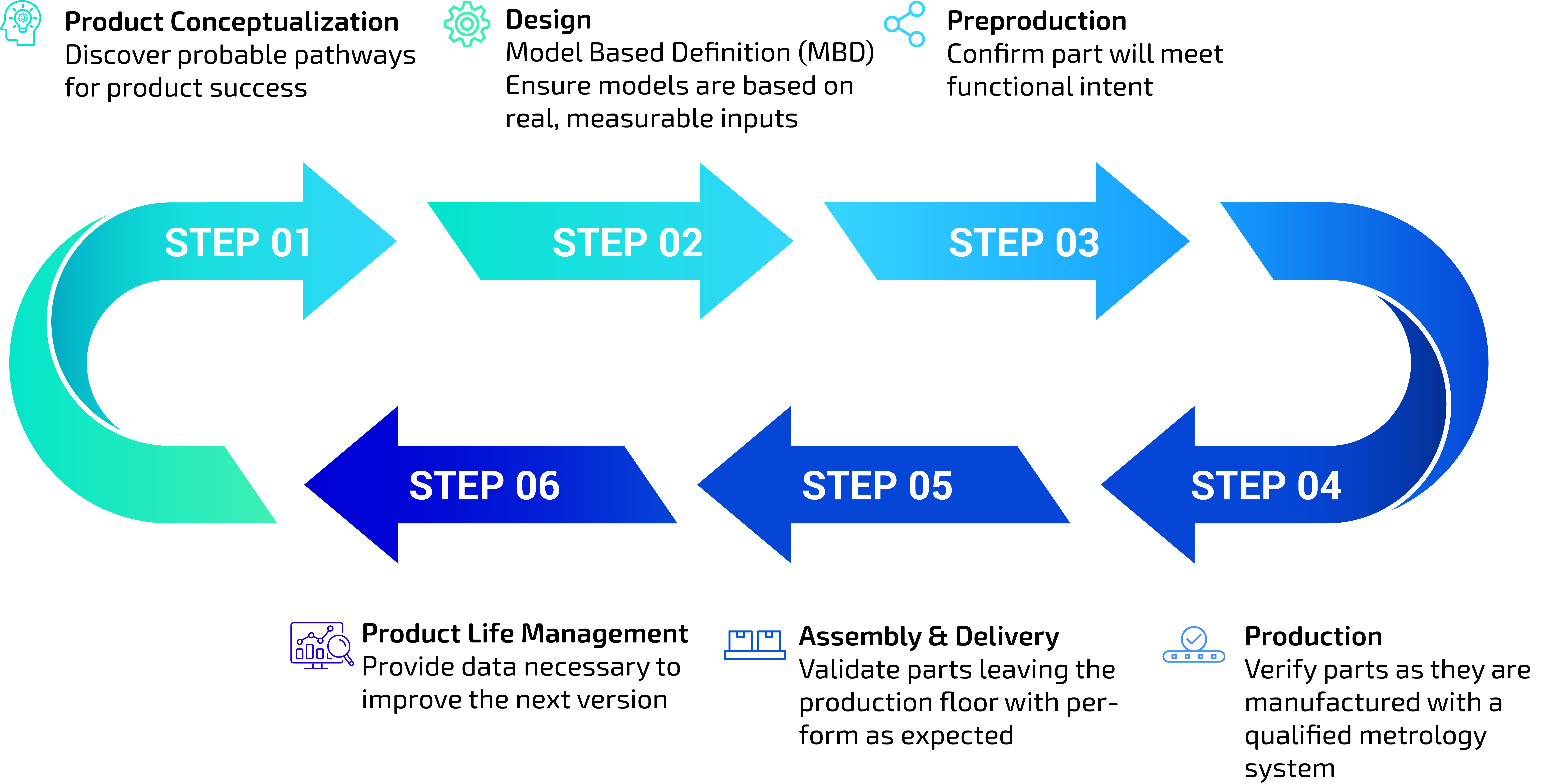
Metrology is central to connecting each stage of a successful product lifecycle. Building metrology into product conceptualization ensures a strong foundation for each subsequent step. During design and pre-production, utilizing Model Based Definition (MBD) determines whether a model’s measurement input accurately meets the functional intent of the workpiece. Establishing qualified measurement systems prior to production ensures that decisions made up to the point of production remain valid. As production begins, measurement systems are used to verify that components meet defined specifications, requiring not only capable equipment but also well-defined acceptance criteria grounded in functional requirements.
Following production, measurement data supports final acceptance, validation, and delivery. In-service performance data and continuous improvement loops further extend the role of metrology, enabling organizations to refine designs, optimize processes, and improve overall product reliability. At each stage, the effectiveness of downstream decisions is dependent on the validity of upstream measurements.
Breakdowns in measurement validity can present in multiple ways. In some cases, components may consistently fail inspection yet perform as intended in application, indicating that the measured feature or tolerance may not be functionally relevant. In other cases, components may pass inspection but fail in the field, often revealing gaps in measurement capability, specification development, or process control. Both scenarios point to a common issue: a disconnect between measurement practices and real-world performance.
“The nature of metrology is to make a good decision,” says Keith Summers, CEO of PQI. “There are thousands of possible influences that are going to affect that decision. Our job is to identify and provide the data to continuously improve the manufacturer's process. The more they make, the better they are going to be.”
What Makes a Measurement Trustworthy?
A measurement is only as reliable as the system used to produce it. Establishing trust in measurement requires demonstrating that the technology and operating procedures are fit for purpose. This is proven through a Gage Repeatability & Reproducibility (GR&R) study, Tolerance to Uncertainty Ratio (TUR), and an Estimated Uncertainty Study at 95% Confidence (UNC 95).
The industry standard acceptance guideline is a TUR of 4:1 at a confidence level of 95%. This benchmark ensures that the measurement system is capable of reliably distinguishing between conforming and nonconforming features.
When this relationship is not achieved, decision risk increases:
- False acceptance allows nonconforming parts into service
- False rejection drives unnecessary cost and inefficiency
In both cases, the issue is not the part itself, but the lack of confidence in the measurement process used to evaluate it.
Responsibility Beyond a Technical Requirement
Metrology serves as a critical enabler of consistency, reliability, and accountability across complex systems. By ensuring that measurements are valid, organizations can support better decisions, reduce risk, and maintain confidence in both their processes and the parts they produce.
Policies and regulations rely on accurate, defensible data to guide decisions that affect safety, performance, and compliance. That trust is established not at the point of policy creation, but at the point of proven measurement validity.
The strength of any decision—whether on the shop floor or at the policy level—depends on the ability to answer a single question with certainty: Are the measurements correct?
PQI and AIS are proud to share our Making Good Decisions poster series designed to help manufacturers evaluate measurement validity and arrive at the right numbers with confidence.